
Valleys can overload a short section
Custom, multi-plane roofs may concentrate water at one inside corner. Gutter capacity, outlet placement, and the downspout route should respond to that high-flow point—not only the total length of the elevation.
Move roof runoff through a connected system built around the roofline, mature tree cover, and the downhill path water follows after it leaves the downspout.
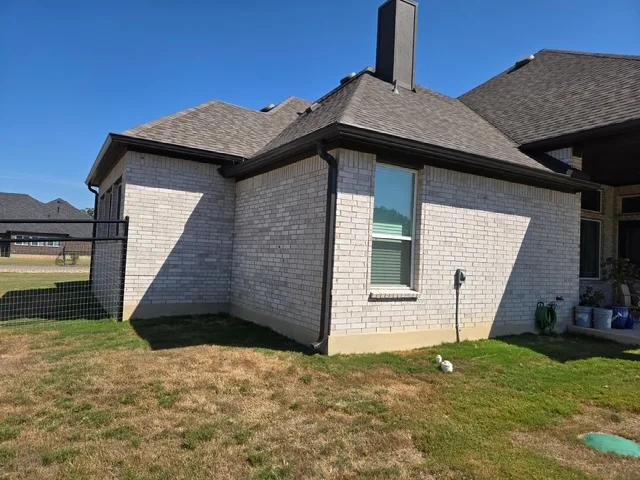
A gutter system should collect runoff, move it through clear outlets, and release it where the property can accept the flow without sending water back toward the building or across a patio, walk, or drive.
See all gutter services in Fair Oaks RanchCustom, multi-plane roofs may concentrate water at one inside corner. Gutter capacity, outlet placement, and the downspout route should respond to that high-flow point—not only the total length of the elevation.
Mature oaks and cedars can send leaves, needles, pollen, and small material toward outlets. A new system should keep those areas serviceable and leave room to discuss leaf protection without treating it as maintenance-free.
A downspout collects water from a broad roof area and releases it at one point. On a sloped lot, that point should account for landscaping, walks, lower walls, drainage features, and the direction water already wants to travel.
Seamless runs reduce joints along straight sections, but the run alone does not solve drainage. The roof edge, outlets, downspouts, and ground-level exit have to work as one route.
Explore S&H gutter installationMeasure each elevation and note roof planes, valleys, corners, drip-edge details, access, and the condition of the attachment surface.
Choose positions based on runoff concentration and practical routes around doors, patios, drives, walkways, beds, and visible elevations.
Install the selected runs and components, then check the route from the roof edge through each downspout to its discharge point.
Questions about a 40-foot run or a per-foot price are reasonable starting points, but they do not show the complete scope. Two homes with the same gutter length may need different numbers of corners, outlets, downspouts, access points, or roof-edge preparation.
S&H offers practical seamless aluminum and can discuss steel or copper when the roofline and exterior call for a different material. If HOA or architectural requirements apply to your property, confirm the visible profile, color, and downspout route before scheduling the work.
Learn how roof geometry, fascia condition, tree cover, downspout routes, and material choices affect a seamless gutter installation for your property.
The scope depends on more than linear footage. Roof height and access, corners and valleys, fascia condition, material, gutter profile, outlet count, downspout routes, removal of an old system, and the available discharge areas can all affect an estimate. A roofline-specific review is the clearest way to price the work.
A short, simple run may look straightforward, but the full job includes working safely at height, setting consistent slope, fastening into a sound roof edge, sealing corners and outlets, and choosing downspout destinations. Complex or elevated Fair Oaks Ranch rooflines leave less room for error, so professional installation is often the practical choice.
Seamless runs reduce joints along straight roof edges and can be formed to the measured length of the elevation. Color, material, corners, outlets, and visible downspout routes should be considered together so the finished system supports both drainage and the exterior design.
They may be useful where mature oaks, cedars, or other nearby trees send recurring debris to the roof. The decision should follow the gutter layout: first size and route the runs, outlets, and downspouts, then choose protection that suits the debris and preserves access for future inspection.
Tell S&H which roof edges need coverage, where water lands now, and what the slope or tree cover looks like. Request an estimate built around the property.